Running MMSSTV Under Linux

If you have been receiving SSTV, then you’ll typically know the go-to application is MMSSTV by JE3HHT. It’s s as old as the hills, first released in April 2002 and runs on pretty much anything. I find that its TX template design is particularly good to use.

If you have been a Linux enthusiast, then the go to application to run windows applications is WINE. It’s as old as the hills, with development starting in 1993 and runs on pretty much anything.

Not being entirely happy with QSSTV’s UI, I went about seeing if MMSTV could operate under WINE.

Read more

Just what is NET/ROM?

Introduction

One of the things that was important to get working this time around with my Linux TNC Node interface was the concept of a “NET/ROM”. Perhaps naively in a post-internet world, my mind jumped to this being a gateway between nodes available via radio and via the internet, meaning I could connect to any BBS around the world that is using “netrom”. The reality is a lot more complex.

According to the Linux Programmers Manual (man netrom)

“NET/ROM  is  a  protocol used extensively by radio amateurs. The Linux NET/ROM protocol family permits access to these protocols via the standard networking socket metaphor.”

It would appear that NET/ROM is a protocol, not a gateway, and it overlays on top of AX/25 to provide a network stack. Poking around online, the Linux Amateur Radio AX.25 HOWTO says as much:

“The NET/ROM protocol is an attempt at a full network protocol and uses AX.25 at its lowest layer as a datalink protocol. It provides a network layer that is an adapted form of AX.25. The NET/ROM protocol features dynamic routing and node aliases.”

So what is NET/ROM?

Read more

Rig Control with RUMlogNG

My workspace for my radio gear is pretty limited, therefore space is at a premium. The Toshiba Tecra M2 which I used as my station computer for many years finally reached the end of its life, with none of the major operating systems supporting non-PAE chipsets. Not ready to purchase a laptop just for radio operations, I was hoping that I could use a more contemporary platform for operations – an iPad.

A quick search around and I came across RUMlogNG, which is easily the best logging interface I have seen in a ham radio iPad app that is modestly priced.
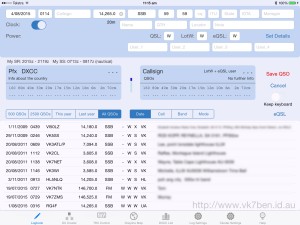
RUMlogNG Logging Page

One of the more interesting features was that basic interaction with your radio was possible (reading of frequency, mode), with the suggestion to use one of Pignology’s Piglets. Reading the specifications of the piglet, it became apparent that what it was doing was taking the serial CAT interface of the rig control, and making it accessible over wifi network to connected devices by streaming the serial data out of a TCP port.

Armed with this information, went looking for alternative ways to connect serial interfaces to RUMlog, and happened across this forum post, talking about an app called remserial. After attaching a Serial to USB Converter to a Raspberry Pi, I was able to run the below command as root:

pi@raspberrypi ~/remserial-1.4 $ ./remserial  -p 7373 -s "9600 raw" /dev/ttyUSB0

The app did not crash when I tried this, so I assumed it was running, and then configured RUMlogNG to connect to the Raspberry Pi on port 7373. Success! RUMlog did not throw any errors and back on the logging screen, I saw that frequency and mode was being updated off the radio.
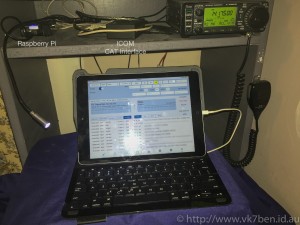

Rig Control with RUMlog