ARISS SSTV Event 26 -Humans in Space

Over the past week, amateur radio operators have been enjoying receiving SSTV images from the International Space Station (ISS) celebrating April 12, the International Day of Human Space Flight.

As you may have seen before, there is quite an active local group of Amateurs who tune in for space SSTV events, and this one was no different, with images being shared in the REAST discord by:

  • VK7BEN
  • VK7TW
  • VK7OO
  • VK7ZBX
  • VK7TO

This event has been particularly challenging, with deep fadeouts (QSB) impacting reception. In some cases I have created a composite image, stitching several “bad” images together to form one good image:

Read more

Switching QSO Logging to Wavelog

Main Dashboard of Wavelog, depicting a global map showing the last 20 contacts, as well as QSO details

Over this past week I have taken a leap of faith and moved my contact logging platform to Wavelog

Ever since I first obtained my amateur radio license some 20 years ago, I have used Ham Radio Deluxe which truly has been the “Swiss Army Knife” for the casual amateur radio operator, primarily incorporating multi-rig control, logging, digital modes and satellite tracking. It’s a great application and I have no problem in recommending it, but it’s slow development roadmap has resulted in me seeking an alternative.

My hand was ultimately tipped by Microsoft’s announcement that support for Windows 10 ends in October. Normally this would not be an issue, I would just upgrade to Windows 11, but unfortunately it would appear my CPU is no longer supported with the only solution being to upgrade the hardware to something newer. In true ham radio frugal fashion and as an IT professional by career, I think this is a load of bollocks. Having been given several earlier generation Lenovo Thinkcenter computers in the past that are more than capable for my needs, it would appear I need to revisit whether Linux is a viable option for the ham radio shack in 2025.

Read more

Just what is NET/ROM?

Introduction

One of the things that was important to get working this time around with my Linux TNC Node interface was the concept of a “NET/ROM”. Perhaps naively in a post-internet world, my mind jumped to this being a gateway between nodes available via radio and via the internet, meaning I could connect to any BBS around the world that is using “netrom”. The reality is a lot more complex.

According to the Linux Programmers Manual (man netrom)

“NET/ROM  is  a  protocol used extensively by radio amateurs. The Linux NET/ROM protocol family permits access to these protocols via the standard networking socket metaphor.”

It would appear that NET/ROM is a protocol, not a gateway, and it overlays on top of AX/25 to provide a network stack. Poking around online, the Linux Amateur Radio AX.25 HOWTO says as much:

“The NET/ROM protocol is an attempt at a full network protocol and uses AX.25 at its lowest layer as a datalink protocol. It provides a network layer that is an adapted form of AX.25. The NET/ROM protocol features dynamic routing and node aliases.”

So what is NET/ROM?

Read more

AX.25 Packeteering Part I

Initial Packet Radio Setup, a PacComm TNC-320 attached to an Icom IC-706MkIIg, both powered on with the radio n 147.575Mhz FM
Packet Radio with a PacComm TNC-320 and Icom 706MkIIg

It really doesn’t feel like it was that long ago since I wrote about packet communications, however it is just over 9 years already, which is frightening for a variety of reasons.

Packet radio is close to my heart as providing a glimpse of computer communications prior to the advent of what we now know as the Internet. Most if not all of the pre-internet telecommunications infrastructure in Australia now only exists in museums or has been scrapped for metal. We’re at least one demographic generation in that have never heard a dialup modem handshake before outside of a YouTube video.

This may be the second time I have posted about packet radio, but this time I will be taking a much deeper dive.

Read more

Worked All Continents

Well that was a long time coming.

Was excited to finally get my the last confirmed QSL needed from Pieter V51PJ in Namibia to successfully achieve working all continents. Africa and Antarctica have been (unsurprisingly) difficult to obtain a QSL from, but with Igor operating RI1ANE and exceptional propagation conditions, it had left Africa as the last bastion holdout for the award.

The eQSL eWAC for some reason was slightly easier to obtain, requiring only 6 continents. I can only assume that this was to remove the difficulty in working Antarctica.

While enjoying the achievement, it gave me the opportunity to go back through the log and find some interesting things:

  • This past month was not the first time I have worked a Russian Antarctic station. Back in back in 2006 as VK7HAH, I worked Alex R1ANC at Vostok base on SSB – which I think is a bit of an achievement.
  • Speaking on Antarctic and 2006, I also worked Paul VK0JLX, who was based at Davis Station at that time, also on SSB.
  • My first international contact was on the 10 October 2006, with Igor RA3CQ.
  • My first international contact as VK7BEN was March 23 2007 with VR2NN, a contest team.
  • First weak signal contact was with Ian VK2IE on 27th August 2015 using JT65. rx-04, tx-01.
  • First FT8 contact happened on 16 July 2017 with Phil VK5RM rx-16, tx-05.

So there we have it, my pathway to obtaining Worked All Continents using digital modes. with DXCC being the next goal, but with 33 confirmed QSLs still needed.

I guess I will see you all on the air!

RD Contest 2017

RTTY QSOs during 2017 RD Contest

The 2017 RD Contest was over the weekend of August 12-13 and I was keen to participate this year, having been unable to participate last year due to my involvement in the Festival of Bright Ideas. With Tasmania winning the state vs state competition, I was keen to do my bit to defend that title.

With the waning solar cycle leading to pretty poor propagation conditions in my near NVIS antenna setup, my focus had been working local stations on VHF and higher bands. Critically, I was now in a position to take advantage of the allowed RTTY digital mode, which was worth double points on 144Mhz and 430Mhz, 4 points on the 23cm band, and a triple multiplier between 1am and 6am meaning there was up to 12 points per contact on offer!

Read more

Giving a FSQ! Instant Messaging on Air

FSQ in fldigi

It seems I don’t get to play on air as much as I would like, but the other day I discovered a video by Kevin KB9RLW talking about this digital chat mode called FSQ. I shared the link with guys in the VK7 Online Chat Room and before I knew it, there were 3-4 people getting set up to use this mode.

Fast Simple QSO (FSQ) has been around since 2014 and is developed by two New Zealanders – Con Wassilieff ZL2AFP & Murray Greenman ZL1BPU. It has some rather interesting characteristics about it such as weak signal capabilities, the ability to send files and pictures and also that commands can be sent  as triggers to remote devices.  The latter is very interesting for propagation reports – being able to send a command out and then have reports given back about your SNR amongst other uses.

Anyway, early days for my experimentation with this mode and I am sure you will hear more from me about it soon!


Power Distribution in the Shack

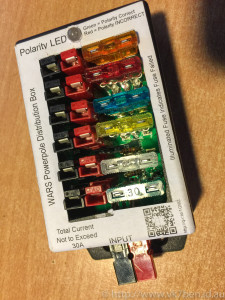
WARS Powerpole Distribution Box

Once you start accumulating more than a couple of pieces of radio equipment, the questions around power supply quickly comes up. Radios can quite easily draw in excess of 15 Amps @ 13.8 Volts depending on the model. My two main HF rigs have a specification of 23.8 Amps and 18 Amps respectively. This is generally more than your standard off-the-shelf supply.

For domestic consumption, linear type supplies (Transformers) are only really viable up to 25-30amps. After that the cost starts going up significantly, as does the weight of the unit. Thankfully switch-mode technology seems to have come a long way in recent years, which resulted in me purchasing a 40 Amp power supply, and no noticeable RF QRM.

With power sorted out, the next thing to deal with is how to get the power from the supply to the devices. With a 40 Amp supply, you can power a whole lot of things, but I quickly discovered the posts only allowed me to connect 2 devices after I attached lugs to the leads. Also, lugs generally are not that portable going across different power supplies – what works on my QTH setup will not work in my car, or at someone else’s house. There had to be a better way.

Read more

QSL Cards

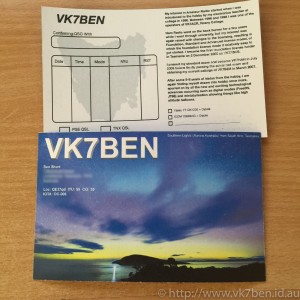
QSL Card

“A QSL Card is the final courtesy of a QSO” – ARRL Operating Manual for Radio Amateurs

In recent years online QSL services such as eQSL and the ARRL Logbook of the World would have you believe that confirming DX QSOs has moved into the electronic world and QSL cards are no longer required, however I still find it quite enjoyable to receive real paper QSL cards in the mail – I think its a lot more personal knowing that someone has gone to the effort of sending you a card rather than having a computer automatically generate a message and upload to the internet. I’m not the only one, with local operator VK7GN having an amazing QSL collection that was featured on TV.

It’s been a long time since I made up QSL cards. My last QSL cards were single sided, with 1/3 of the card taken up by a picture of my IC-706MkIIg and the brief information and QSO details. This was printed onto matte 4×6 photo paper and I wrote on them and sent when QSL cards were received. I wasn’t terribly happy with these as they felt a little cheap and flimsy, and were not the standard QSL card size of 140mm x9 0mm.

Following the OCDX Contest I felt it was inevitable that I would start receiving QSL cards again and that I should have some QSLs cards of my own to reply with. I started by searching the web for QSL card printers, and while many were out there the pricing was getting expensive (the $AUD has *tanked* in the last 12 months) and not being sure of the quantity I required it was a bit of an undertaking, so I decided to create and print them myself.

Using Photoshop and Pixelmator and using one of the photos I took of the Aurora Australis, I had a look around online at what some other QSL cards looked at before finishing my design. After that I had a bit of fiddling to do to get the card front and reverse to line up and fit 3 to a A4 piece of card to print. I then trimmed to size with a guillotine.

I am pretty happy with how these have come out. They look good, they feel good, and I will be happy to start sending them out as QSO confirmations as I receive QSL Cards.
 

Everything Old….

The last time I was active on air was a brief period in 2011. During this time, I just wasn’t that interested in radio and it took a back seat to other projects and interests.

Fast forward to July 2015. My lovely partner has gone overseas for a few weeks and I decided to spend a couple of evenings at my local radio club which holds amateur TV nights most Wednesday evenings. This wasn’t new to me. What was new however was a couple of work colleagues deciding to come up with me and the discovery that the stuff I couldn’t do before I now could, especially having bought a contemporary new transceiver.

So now I find myself not knowing which way to go first with many of these “old” things (and not so old) that are all new to me again:

  • VK3YT’s endeavours with High Altitude Balloons I find just amazing, and can easily see this becoming science projects in high schools or colleges, promoting amateur radio, electronics and further research.
  • JT65 Weak Signal Modes being used for high altitude balloons, HF communications, EME, Meteor Scatter and a whole range of other types of communications that are just not suitable for voice communications
  • Traditional Modes such as BPSK, RTTY and STTV, and more exotic modes like THROB, Feld Hell and Contestia. Previously I did not have the hardware available to do this at home. Now I do. Enough said there really.
  • Packet Radio. AX.25. One of the many projects I am currently running with. I have acquired an old TNC, and it’s just a matter of interfacing it with the radio.
  • Speaking of interfacing, I need to make a suitable new interface for my Icom IC-706MkIIG that includes PTT and audio in.
  • Amateur Satellite communications. It doesn’t seem as hard as it sounds remarkably, and I think that would be great fun.
  • FreeDV – The new digital voice mode on the block. it’s achieving some amazing things like FM quality audio with weak signals, and is definitely a QSO mode I want to try.

This, along with station maintenance and improvements is definitely going to keep me busy in the foreseeable future. I’ll touch more on the station maintenance in a later post.